Leading international human rights organisations, opposition activists and others have condemned ongoing human rights violations in Bahrain, during an UK Parliamentary Inquiry into UK relations with Bahrain and Saudi Arabia, affirming that the UK Government is not doing enough to improve the situation in this regard.
The fifth evidence session of the inquiry focused on human rights and democracy in Bahrain and featured verbal testimonies from representatives of Human Rights Watch and Amnesty International, resigned MP Ali Alaswad, Maryam Alkhawaja from The Bahrain Centre for Human Rights and Sir Nigel Rodley, former BICI Commissioner.
In covering Bahrain all speakers expressed their consistent level of disappointment with the lack of reforms and general situation in Bahrain, in addressing the panel of British Parliamentarians. Also notable was the criticism of UK Government policy with suggestions that the UK is failing to properly pressure Bahrain into reforms. Since the end of 2012, the UK Foreign Affairs Committee has been scrutinising UK policy in Bahrain and Saudi Arabia, with previous sessions mainly focusing on trade relations.
On this occasion, MP’s asked to hear what the latest situation in Bahrain is, how far reforms have come and what role the UK has been and indeed should be playing in regards to Bahrain.
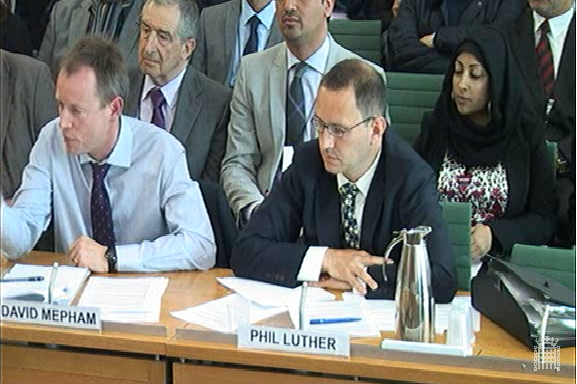
David Mepham (left), Phil Luthor (right)
First to answer questions was Mr. Phil Luthor, Middle East and North Africa Director for Amnesty International, and Mr. David Mepham, UK Director for Human Rights Watch. Mr. Mepham began by laying clear his belief that the UK has “overstated” the level of reforms made in Bahrain, particularly in relation to the Bahrain Independent Commission of Inquiry. He claimed that Britain’s position on BICI implementation has actually been “misleading” and accused UK of “not providing an objective view.” He argued that the level of reform has been far below what is stated by the UK Government.
Mepham cited the examples of both torture and a lack of accountability for abuses as two major areas that continue to be a problem in Bahrain. Ann Clwyd MP asked if torture still exists in Bahrain, with Mepham answering that the evidence obtained by Human Rights Watch suggests that is the case, calling for a serious investigation into these allegations. In terms of accountability, he was equally as critical mentioning that only “junior people” have been held to account in the limited cases of prosecutions relating to deaths of protesters.
The same sentiments were echoed by Amnesty Director Phil Luthor, who said there is a “gap between the rhetoric (of the regime) and the reality in Bahrain. He said that the lack of political will to implement reforms meant that in general Bahrain was either witnessing a “regression” or “good measures being circumvented”. As an example of this regression he mentioned the increase in the penalty for criticising the King and the use of criminal charges in arrests based on freedom of expression, saying that in Bahrain “the law criminalizes freedom of expression.”
Countering Bahrain’s own claims of reform, Luthor added that a number of potentially good measures are being circumvented and are effectively useless. An example he gave was the installation of CCTV cameras in detention centres, to stop mistreatment, as recommended in the BICI. Luthor said that this was being circumvented by new unofficial detention centres appearing, without CCTV, where detainees are still mistreated. He also mentioned that BICI and UPR implementation should be happening ahead of any dialogue and should not be a part of any negotiation as the Bahraini authorities have already committed themselves to these.
With both NGO men agreeing that abuses are still prevalent in Bahrain, they also shared the view that UK is not doing enough to end such abuses and help bring about reform. In addition to Mepham’s claims of “overstating” reforms, he added that the UK should employ more public criticism of Bahrain, mentioning that ruling families “care how they are viewed” and want to be “integrated” into international society. He said a combination of pressure, encouragement and multi-lateral mechanisms would be most effective in bringing about reform in Bahrain and the GCC. Mepham added that the UK efforts to bring about change have not had any impact so far and that the UK has not used its leverage sufficiently and overall should be pushing human rights concern more robustly.
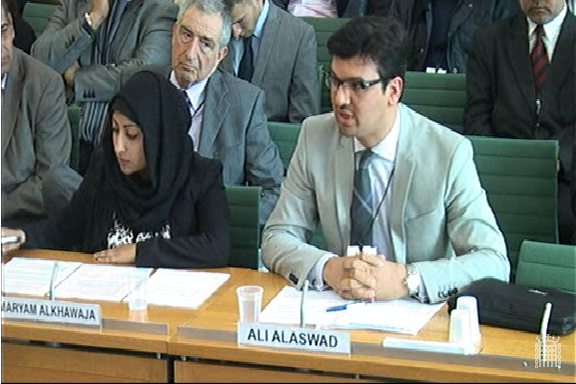
Ali Alaswad (right), Maryam Alkhawaja (left)
The next part of the session saw Bahraini’s Ali Alaswad and Maryam Alkhawaja address the Committee of MP’s. Alkhawaja began by reading a message from an anonymous prisoner in Bahrain, who called for more support from both the British Government and the British public. Alaswad opened by arguing that Britain’s interests in Bahrain are not being met, either in terms of promoting human rights or helping to create a stable Bahrain that is ripe for investment and trade.
Both panelists outlined the current situation, agreeing that the level of excessive force from security personnel is an ongoing problem. Alkhawaja listed the many areas of ongoing concern in bahrain including extrajudicial killings, arrests, house raids, torture, forced disappearance and other issues that she said were a continuation of regime policy since 14th February 2011.
On the subject of the BICI, Alaswad agreed with the NGO representatives that there has been no implementation of its recommendations. He cited the Project on Middle East Democracy report that claimed only 3 out of 26 recommendations have seen full progress and claimed that implementation should “not just be on paper”, with no change being felt on the ground.
Mike Gapes MP pressed Alaswad on a number of issues, starting with what role the UK should play in the dialogue process. Alaswad replied that the UK should act as a “mediator” or “facilitator” in the dialogue process, with the Bahraini authorities always rejecting this notion. Gapes suggested that the conflict in Bahrain may be sectarian in nature, which Alaswad contradicted by arguing that the authorities have always used this excuse to resist democratic demands, whilst in reality the uprising in Bahrain is purely national. Alaswad also condemned violence from protesters in Bahrain, but argued that it has only ever been as a result of excessive force from the security forces beforehand.
The discussions then turned to questions on what the UK should be doing in its relations with Bahrain, with Alkhawaja arguing that the private diplomacy option is not working and more public condemnation is needed. She said Bahrain refuses to be accountable internally and therefore should be accountable internationally in front of it’s allies. Alaswad agreed with this, saying that if UK continues to treat Bahrain as an unconditional ally, it serves as a “greenlight” to the authorities to continue to commit human rights abuses and refuse reform.
Both also warned of the dangers faced by UK if they continue to be seen as strong allies of Bahrain, without a critical voice. Alkhawaja spoke of a rising anti-UK sentiment in Bahrain, that was fuelled by recent comments of the UK Ambassador to Bahrain in an interview with the pro-Government Gulf Daily News. Alaswad said that regular official visits from members of the royal family to UK, disappoint Bahraini people who look to the UK for support.
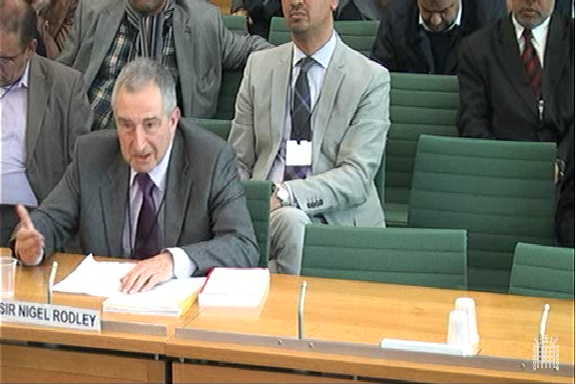
Sir Nigel Rodley
Sir Nigel Rodley, Commissioner to the much discussed BICI, also testified on UK policy in Bahrain. He started off by saying that he has no reason to disagree with the statements of previous speakers that the current situation in Bahrain is not currently a good one. BICI highlighted accountability as a key area that needs to be addressed, with Sir Nigel saying there was not sufficient time to do this fully. However, the “systematic and coherent” level of mistreatment by security forces, meant that orders must have come from high up the “administrative and political level”. He added that training alone of security personnel could not guarantee reforms, saying “it could help but is not enough.” Sir Nigel also registered concern with the idea of training being used to give the impression of change, without it truly happening.
As a former UN Special Rapporteur on Torture, Sir Nigel was vocal in his criticism of Bahrain’s decision to deny entry to the current Rapporteur, Juan Mendez. He said the justifications of being during dialogue were “utterly unimpressive” and that one could suspect that the offer for the visit only existed when pressure was on Bahrain and once that pressured had been lifted, the invitation was rescinded. In relation to the UK involvement, Sir Nigel said he hoped the UK would press for a renewed invitation to the Torture Rapporteur, this time allowing less time for the invitation to be taken away.
In his final comments Sir Nigel made a clear statement that “the Saudis are pulling the strings of the hardliners in Bahrain”, in reference to Ali Alaswad’s discussion of hardliners in the regime. Sir Nigel said my big message to the UK is to “get the Saudis away from supporting hardliners” and that they should do what they can to make space for reformists in the opposition and in the regime.
Caroline Montagu, the Countess of Sandwich, provided evidence relating to Saudia Arabia, as had the representatives from the international NGO’s.
The testimonies provided in the fifth session, struck at claims by the Bahraini authorities about reform and changes and will be an important reference for the UK MP’s when compiling their final report on UK policy with Saudi and Bahrain.
Watch the session in full here:


